
The Heart of Old Arima with Melba Madeira

Updated: May 26
Tucked quietly on Green Street, surrounded by old trees and the soft sounds of birds flying through the verandah, the ancestral home of Melba Madeira holds more than architecture. It holds stories. It holds Arima.
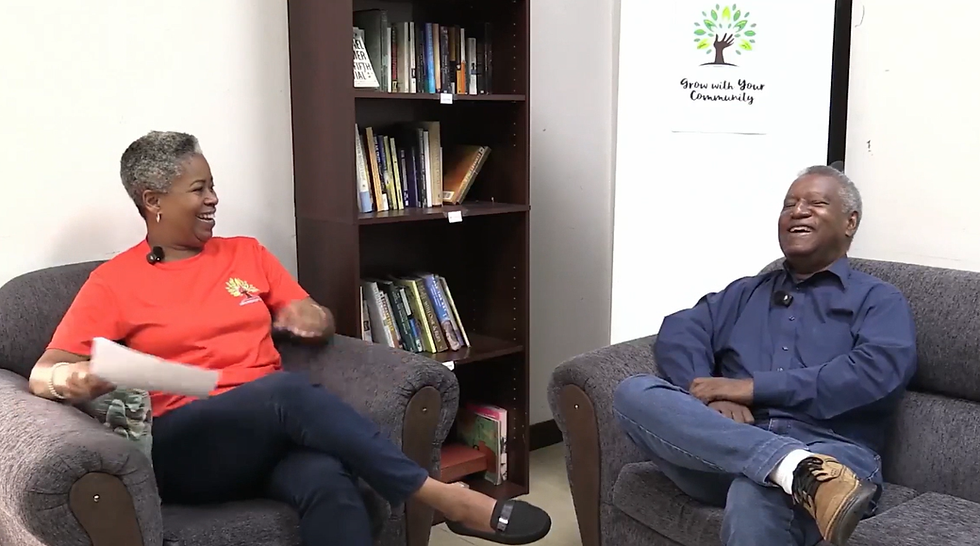
In this special episode of Café Conversations, we visited Melba Madeira (Miss Melba) — proud Gens D’Arime, storyteller, matriarch, and wife of the late broadcaster and icon, Jones P. Madeira — for a conversation that became far more than an interview. It became a journey through the landscape of old Arima and the people who shaped it.

As neighbours called greetings from the road outside and music drifted softly from a nearby shop, Miss Melba shared memories of growing up in a time when the streets were still rubble roads, children played freely from yard to yard, and families looked after one another as naturally as breathing.
She recalled how Jones, whom she would later marry and spend 53 years with, first came to live next door as a little boy and was later taken in by a neighbour who wished to adopt him. They grew up together in a close-knit community where everyone knew each other — the Chooings, the Choo Kongs, De Lisle, Holly’s family, and so many others whose names remain woven into Arima’s living memory.
Old Arima, as she described it, was filled with bushland, pigeon peas, cane fields, ducks, rivers, and horses. The area where Massy Stores now stands was once farmland owned by Mr. Llanis, who invited neighbours to collect cane juice and pigeon peas freely from his harvests. Children crossed rivers on wooden planks to attend school at the convent in Torrecilla. Floodwaters would rise, roads disappeared into mud, and yet there was a deep sense of community safety and belonging.
One of the most fascinating moments came as Miss Melba described the river that once flowed beneath the Dial itself — a reminder that even the physical landscape of Arima carries forgotten histories beneath the surface.
But this conversation was not only about nostalgia.
Throughout the morning, an important idea emerged: that remembering the past is not about trying to return to it. The old days are gone, and every generation must build its own future. Yet there is value in pausing to look back, not to live there, but to understand the journey that brought us here.
As we reflected together, we spoke about history as landscape — about how, every so often, we must stop moving toward the horizon long enough to turn around and appreciate the road behind us.
That may be the true purpose of conversations like these.
Not merely preserving facts, dates, or names, but preserving feeling. Preserving the humanity of a town. Preserving the spirit of neighbourliness, resilience, simplicity, and quiet joy that shaped generations of Arimians.
Even now, Miss Melba remains deeply rooted in the community she has known all her life. Though encouraged many times to leave the old family home, she stays — surrounded by memories, trees, music and the familiar rhythm of the neighbourhood she still loves.
And perhaps that is what this episode revealed most clearly:
Arima is not only a place. It is a living inheritance carried in stories, voices, relationships, and memory.
At the Arima Community Centre, we believe community is built not only through programmes and events, but through conversations like these — conversations that help us understand who we are, where we came from, and what we hope to pass on.
Because when stories are shared, heritage remains alive.
And as Miss Melba reminded us so beautifully that morning, sometimes joy can still be found simply by sitting quietly on a verandah, listening to the birds, the music next door, and the life of a community continuing around you.
Enjoy the full episode here:
Lorraine Villaroel


Comments